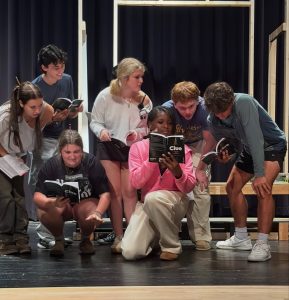
Weddington High’s latest theatrical production, Clue, has concluded! A script loaded with undeniable potential—a blend of humor, wit, sarcasm, and ambience—has come alive. Set designers form a brooding atmosphere; hair and makeup artists create charming reincarnations of familiar personas; actors hypnotically encapsulate spectators into a different world. Such meticulous operations are far from new: at one point, performing arts were one of the few things society had to quell its boredom. Before television, before social media, before streaming platforms, before video games—there was theatre.
Given all the aforementioned modern staples of the entertainment industry, why hasn’t theatre phased out? The rotary phone wasn’t patented until 1892, yet saw its way out by the 90s—a blink of an eye against the passage of time. That’s the world we live in. In 2026, we’ve become accustomed to the new superseding the old in rapid succession. Millions have entertainment at the disposal of a fingertip. You may doom-scroll on Instagram or TikTok for a quick release of boredom. You might binge-watch movies in the comfort of your own home with the convenience of a pause, rewind, and fast-forward button. So why haven’t performing arts—dating back millennia—followed suit in the same “out with the old, in with the new” treatment?
Clue is a paradigm for some of society’s most cherished pillars: collaboration, commitment, and companionship. Many of these qualities are born out of the principles that characterize theatre. However, when we think of theatre, the final show is the only visible metric to audience members. There’s an entire community behind those curtains experiencing something exceptional—something that cannot be replaced by a screen.
Behind the Scenes
To comprehend this community, one must understand the scope of its existence. One of the most unsung aspects of theatre is the sheer amount of work and collaboration behind the scenes. Yes, it’s understood that various people are involved beyond the parameters of the set. Nevertheless, as with many other art forms—the final painting, the final novel, the final print—society inevitably emphasizes the end result. Senior Katie Cortez, assistant stage manager for Clue, experiences this phenomenon firsthand: “People underestimate how big the technical aspects of the show are. Moving the sets, the lighting, costumes, props, all of it is so much hard work.” The hour and a half watching the play pales in comparison to the months of toiling behind the scenes; however, “a lot of times [it’s] under-appreciated.”
Hurdles
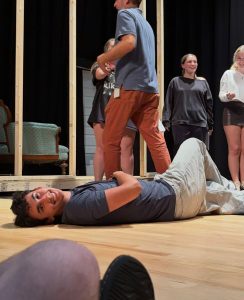
It is not enough for everyone involved to simply coexist. “[Students] learn to work together in a way that I don’t think can be done in the same way,” proclaimed drama teacher and Clue’s director, Dr. Blamy. A delayed set change, a missed cue, a misplaced prop are all common missteps that require cast and crew members to adapt together on the spot. Unlike television production, there are no second takes. Every participant depends on one another to make the performance work: trust is vital. Blamy underscores this aspect as one of the pinnacles of theatre: “Every show, every rehearsal, there’s adversity that kids have to learn to figure out and overcome.”
Meaningful Connections
But what exactly is it about theatre that cannot be replicated by cinematography despite how far we’ve come technologically? According to Cortez, it comes down to connection: “[Theatre] really immerses you, and it’s a completely different experience.” Watching television is often a passive household habit; theatre is a conversation. There’s an undeniably human cadence that’s refreshing to experience. Spectators and actors share moments together: laughter, gasps, and silence radiate throughout a vivacious room. In film, actors are often kept in private holding areas between takes; scenes are shot out of order and later meshed together. It’s a highly technical process.
For actors, performing arts are often much more than a vocational commitment—they’re a catalyst for camaraderie. Junior Cannon Luedtke (Professor Plum) describes the progression of personal bonding along the way as a “communal thing,” where “it is so easy to bring everyone together because you all share one common interest.” A story is told from beginning to end; participants steadily experience each milestone together; they may even steadily grow together.
And these relationships stick. Junior Caroline Gretz (Mrs. Peacock) emphasizes this aspect: “[Theatre] is not just constant work. You find a lot of people who you thought you’d never speak to, who you end up loving, who you end up talking to even after they graduate.” With performing arts often comes an uplifting sense of belonging: an undying keepsake. “It’s unexplainable.”
Priceless Satisfaction
Beyond the applause and beyond the community, there’s an exhilarating sense of personal fulfillment. Doing something incredibly vulnerable in the company of those you value is inspiring. Senior Diego Gonzalez (Mr. Green) elaborates on the rapture of publicly sharing one’s work: “Whether you get the good reactions that you want or not, it’s still such a joy to be able to put yourself out there.” You have to be able to see the value in what you’ve invested your time into before anyone else can—and that’s what makes vulnerability a part of the joy.
Theatre lives on not because it guarantees success. Not because it guarantees recognition. Not even because it’s some holy grail of personal achievement. Theatre reminds us that everything we do doesn’t have to constantly be justified by perfection or external approval: we’re reminded of what we wanted to do in the first place. Senior Norarose Enow-Tanyi (Ms. Scarlett) sums it up perfectly: “Get out of your nerves. It’s not embarrassing. It’s just fun.”