
The college application process can be very stressful for students: there are many important decisions to be made. Yet people don’t always know or talk about the differences between Early Decision, Early Action, and Restrictive Early Action.
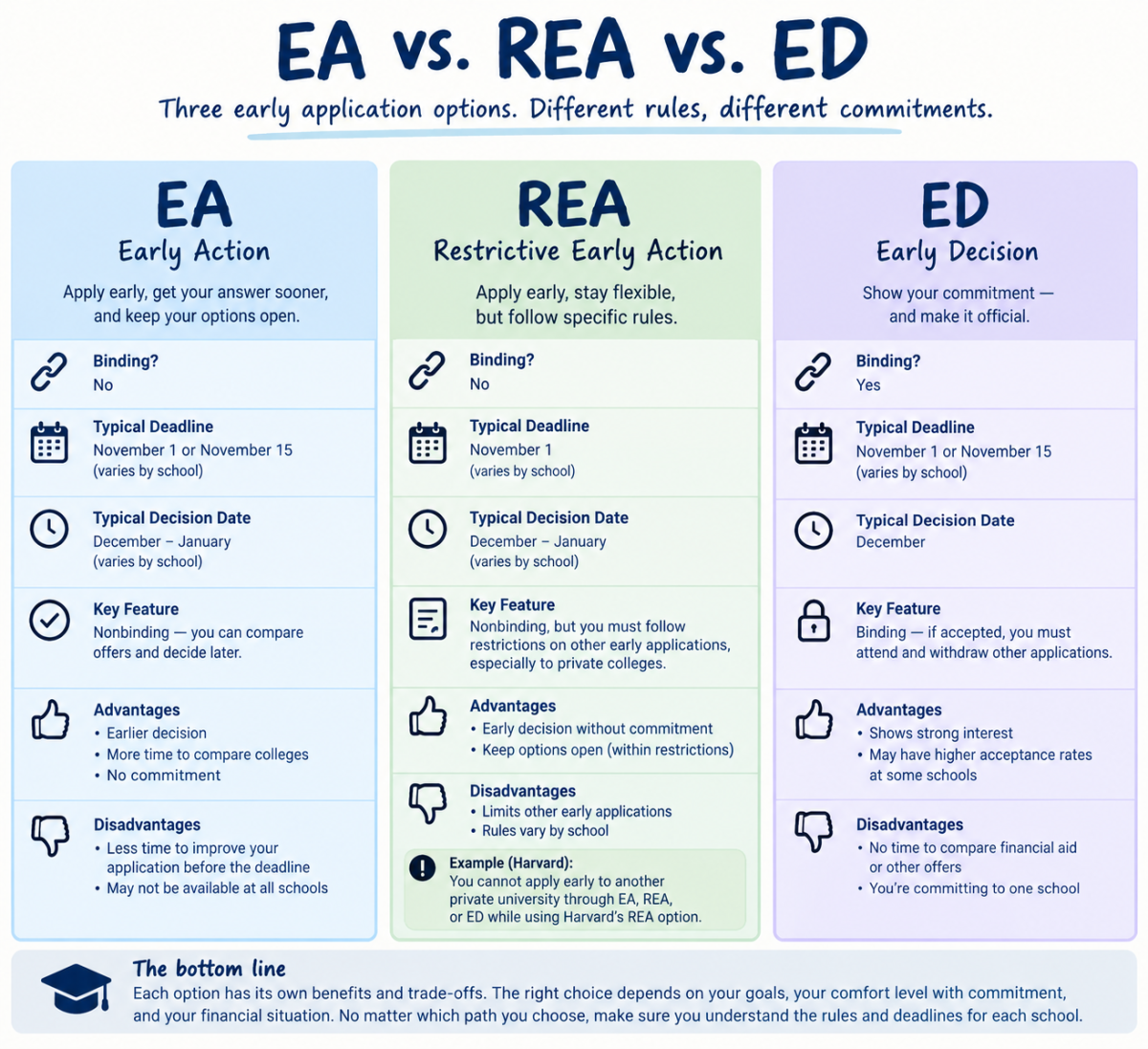
Early Decision (ED) is an application plan that allows students to apply to college early. However, ED is binding: if accepted, you are expected to attend that college and withdraw all other applications. Most ED deadlines fall between November 1 and November 15. Decisions are usually released in December. A major advantage of ED is the strong interest students are able to demonstrate for their first-choice universities. However, there is flexibility to compare financial aid offers and other college possibilities.
Early Action (EA) has a similar concept: students apply early and are able to receive decisions sooner. Most EA deadlines fall between November 1 and November 15. Decisions are typically released in December or January. Unlike ED, however, EA is nonbinding. This provides more flexibility: students can compare their options before choosing where to attend. However, applying early means less time to improve grades, test scores, and essays before submitting an application.
Restrictive Early Action (REA) is another option offered by some colleges. Much like EA, REA is nonbinding. However, restrictions are put on applying early to other colleges, particularly private universities. For example, students who apply to Harvard through REA cannot simultaneously apply to another private university through EA, REA, or ED. They may be able to apply early to public universities through nonbinding programs, but each college has its own specific rules. Most REA deadlines fall around November 1, and decisions are usually released in mid-December. Ultimately, students are able to receive an early decision without making commitments, but restrictions may limit their other early application options.
ED could be a great option for students who have a clear first-choice college and are comfortable committing to it, while EA and REA allow students to apply early without the pressure of commitment. Keep in mind, however, that applying early does not automatically increase your chances of acceptance. It is important to research each college’s admissions policies before deciding.
“The most important thing is to find a college that fits your goals and to make sure you understand your options before making a decision,” underscores counselor Mrs. Washington. The greatest priority is choosing the application plan that works best for you.
Best of luck to seniors going through the college application process right now; may the odds be in your favor!